How do people around the world celebrate periods?
In some countries around the world, families and whole communities celebrate a girl reaching puberty as a coming-of-age occasion. Find out how first periods are acknowledged and celebrated from the UK to Japan.
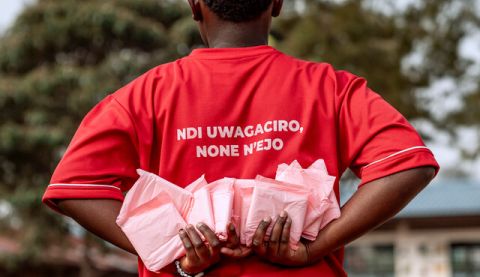
What are the ceremonies, rituals and celebrations that cultures perform to mark girls' first periods? Photo: Christie Ntwari/ActionAid
In many parts of the world, period stigma and taboos mean women and girls are excluded from regular day-to-day activities like attending school, or earning a living. In some cases, women and girls are even prevented from living in their homes, eating certain foods, taking part in religious activities or socialising while they are on their period.
It shows up in different ways - from restrictions on daily life in Malawi to isolation practices in Nepal, holding girls back and putting their health and safety at risk.
However, there are some customs and cultures around the world where periods are acknowledged and girls reaching puberty is fêted.
Periods in Brazil
Girls from the Amazonian Tikuna tribe (indigenous people who live in Brazil, Colombia, and Peru) spend three months to a year living in private rooms in their family homes after they get their first period. During this ‘pelazon’ time girls learn the history of their tribe, study its music and learn their beliefs from other tribe members.
It is a rite of passage for all girls entering womanhood. This period ends with a celebration and the girls are welcomed back into the community. Unlike similar practices like Chhaupadi where girls in Nepal are relegated to sheds or huts during their periods, girls from Tikuna tribe consider the pelazon as a positive occasion where they can focus on themselves and learn about their heritage.1
Period ceremonies in Fiji
In Fiji, some communities lay out a special mat for girls on their first period and teach girls about the importance of this milestone. One the fourth day of their period, an occasion called ‘tunudra’, the girls' families prepare a feast to celebrate their daughters' entry into womanhood.2
Puberty ceremonies in India
In some south Indian communities, a girl’s first period is welcomed through a coming-of-age ceremony called Ritusuddhi or Ritu Kala Samskara or a half-sari function. The girl receives gifts and wears a traditional outfit called Langa Voni which is a skirt and sari outfit, also known as half-sari.
This ceremony marks the transition of girls who have reached puberty and are now mature enough to understand their responsibilities towards family and society.3 However, there is still shame and stigma surrounding periods in other parts of India.
Celebrations in Japan
In some places in Japan, when a girl first gets her period the family celebrates by eating a traditional dish called sekihan made of sticky rice and adzuki beans. The red colour of the dish symbolises happiness and celebration.4
Period rituals in North America
The Native American tribes in North America pay tribute to girls reaching puberty with a celebration called The Sunrise Ceremony. The ceremony involves different rituals where girls from the tribe receive and offer gifts. The girls wear symbolic outfits and celebrate with a feast.
The North American native culture considers the shift from childhood to adulthood as a critical moment in the life of their children and they observe several coming-of-age rites to assert their traditional and community values.5
Periods in the United Kingdom
While not a cultural celebration, access to period products in the UK has become an important step toward dignity, equality and education.
Since 2020, free period products have been available in schools across England as part of a government scheme to tackle period poverty and stigma. This support continues now, helping ensure that no student misses school because they can’t afford essential products.
Alongside this, period products are now widely available for free in many public spaces, including libraries, universities and community centres. Scotland has gone even further, becoming the first country in the world to make period products free for anyone who needs them under the Period Products (Free Provision) Act.
The Department for Education recognises that period poverty and stigma can still act as barriers to learning. Continued investment in access, education and open conversations about menstruation is key to ensuring that all young people can attend school with confidence and participate fully.
While progress has been made, stigma hasn’t disappeared and for many, access is still inconsistent. That’s why ongoing efforts to normalise periods and expand provision remain just as important today.
How ActionAid celebrates periods and sexual and reproductive rights
At ActionAid, we work with local communities around the world to change the negative discourse around periods and normalise coversations around periods and menstrual health.
For example, ActionAid has worked in Nepal since 1982, supporting local women’s rights organisations and youth activists across the region who have been leading conversations in their communities around menstrual dignity, safety, health, and rights. Their work has focused not only on challenging stigma around periods, but also on improving access to menstrual health and rights education, affordable menstrual products, and workshops where women and girls can learn to create reusable pads and develop safer washing and toilet facilities.
Through partnerships with these locally-led initiatives, communities have been able to create safer, more equitable alternatives and move away collectively from chhaupadi. This collaborative work has supported the creation of 11 chhaupadi-free communities, and more than 1,400 women have chosen to stop practising chhaupadi.
Find out more about the work we do to end period stigma and menstruation taboos.
How can I help?
Across the world, ActionAid works alongside women and girls to create practical, lasting solutions to period poverty and period injustice.
Training women to make reusable pads
In many of the world’s poorest countries, we work with community-based women's rights organisations who train girls on how to make reusable sanitary pads that are affordable and sustainable.
Girls’ clubs and safe spaces
We support girls’ clubs where girls learn about their bodies, menstruation and health, build confidence and advocate for their rights. We also help set up girls’ rooms in schools: safe, private spaces with access to products so girls can manage their periods without shame.
Emergency menstrual kits
In humanitarian crises, we distribute kits containing menstrual products, soap and clean underwear so women and girls can manage their periods safely and with dignity.
Challenging stigma
We work with communities to shift harmful attitudes and end stigma so women and girls can live free from shame.
You can help by donating to help us end period poverty and period stigma.
Footnotes
- 1ttps://www.refinery29.com/en-gb/2016/07/115824/amazon-tikuna-menstruation-ritual
- 2Biturogoiwasa, Solomoni. My Village, My World: Everyday Life in Nadoria, Fiji. Suva: Institute of Pacific Studies, The University of the South Pacific, 2001
- 3Heidi Munan (2012), Hindu Puberty Rites in CultureShock! Malaysia: A Survival Guide to Customs and Etiquette.
- 4Lebra, Takie Sugiyama (1985). Japanese Women: Constraint and Fulfillment. University of Hawaii Press. p. 72. ISBN 978-0824810252.
- 5Carol A. Markstrom, Empowerment of North American Indian girls: ritual expressions at puberty (University of Nebraska Press, 2008)