Colombia
How ActionAid and partners work in Colombia
Poverty in Colombia has halved over the last 10 years, but it remains one of the countries with the highest income inequality in Latin America.1
31% of the population live below the poverty line - around 16 million people’.2
There are marked differences between outcomes in rural and urban locations: extreme poverty is over three times higher in rural areas, and moderate poverty 55% higher.
In 2025, over 13 million people faced insufficient access to food, driven by conflict, displacement, and recurring floods and droughts.
Colombia ranks among the top four countries globally for internally displaced persons, with over 6.9 million people displaced by conflict.
Women’s rights in Colombia
In Colombia women are more likely to be unemployed, or employed in low-quality, low-paid jobs for a number of reasons, including the impact of unpaid work like caregiving and housekeeping, which often falls to women.3
Women carry out 7.23 hours of unpaid work per day on average, compared to 3.10 hours per day for men.4
Colombia also continues to face one of the world's largest internal displacement crises, with an estimated seven million internally displaced persons (around 14 per cent of the population) in the country recorded in 2023. Women and girls are particularly vulnerable to conflict-related sexual violence and other forms of violence.5
Many women in Colombia also experience violence in everyday life. According to the Colombian Institute of Forensic Medicine, over 23,000 cases of sexual violence were reported in 2017, 85% of them against women.6
Delivering humanitarian assistance following the 2026 earthquake
Colombia was devastated on 10 August 2026 when a magnitude 7.4 earthquake struck near San José del Palmar. More than 250 people were killed and thousands of homes were destroyed.
Egido Sanz, acting Country Director, ActionAid Colombia, said: “We are prepared to respond to this humanitarian emergency to meet the population's most immediate needs – including cash assistance, food, basic and women-specific hygiene items, and health and gender-based violence prevention services – with particular attention to women, children, and people in situations of greater vulnerability.”
The most urgently-needed items include shelter, food, safe water, along with hygiene and health kits.
While immediate humanitarian assistance is needed, ongoing support through ActionAid’s local partners over the coming months and years will be crucial in helping those impacted by the earthquake return to their normal lives.
Donate to ActionAid's Colombia Earthquake Appeal.

Karen Juliana Beltrán and the Women's Advisory Council
AA Colombia
Defending children's and women's rights during conflict
El Plateado is a rural district in Cauca. Since the 1990s is has become a strategic point for guerrilla groups due to its location in Colombia's western mountains. Clashes here between Colombia's army and illegal armed groups have become more severe in recent years leading to forced displacement of many local civilians.
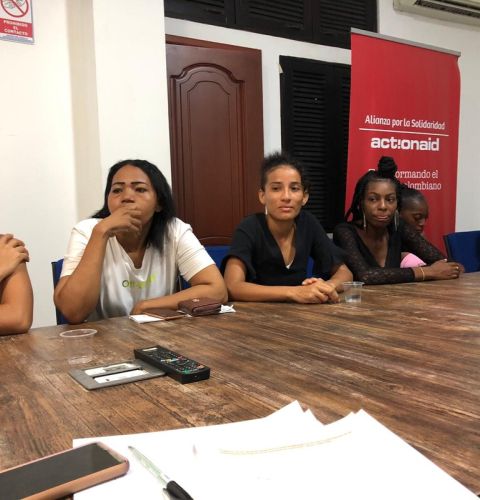
Karen Juliana Beltrán is one of the founders of the Women's Advisory Council, a ActionAid partner working to support local women and children in the area.
Her two-pronged approach involves lobbying institutions to take note of their region and advocating for gender responsive services but also movement building in the community and creating a safe space in the women's house for people to meet, has been effective.
"Women started filing complaints. Many hadn’t done so before due to fear - and other times, and I always say this in meetings with both men and women - sometimes we blame the victim," she says.
Footnotes
- 1https://www.worldbank.org/en/country/colombia/overview
- 2https://pip.worldbank.org/country-profiles/COL
- 3http://www.oecd.org/economy/surveys/Colombia-2017-OECD-economic-survey-overview.pdf
- 4https://www.oecd-ilibrary.org/sites/99444453-en/index.html?itemId=/content/component/99444453-en
- 5
https://www.gov.uk/government/publications/colombia-country-policy-and-information-notes/country-policy-and-information-note-internal-relocation-colombia-march-2026-accessible
- 6https://www.oecd-ilibrary.org/sites/99444453-en/index.html?itemId=/content/component/99444453-en
Page updated 20 August 2026